


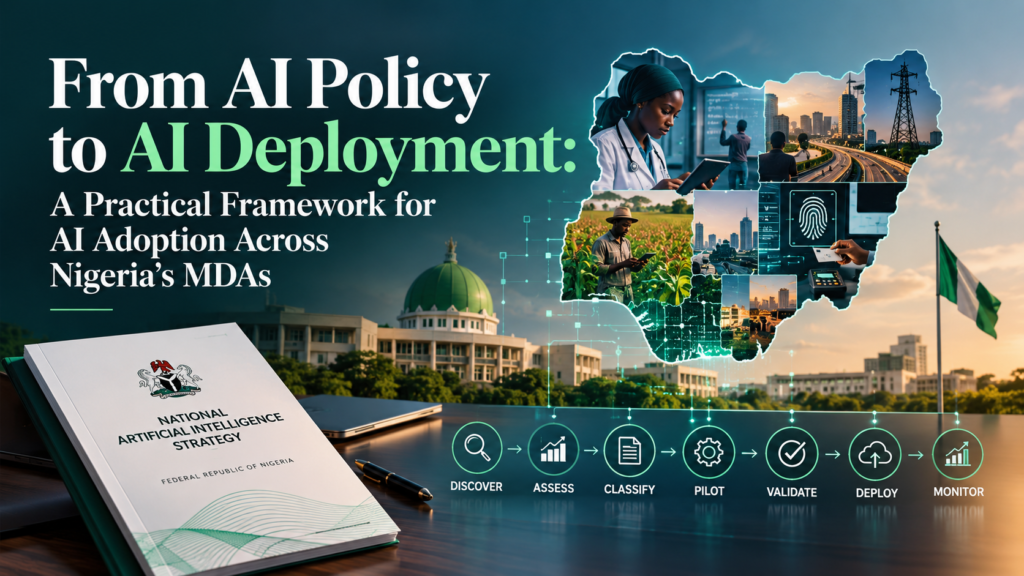
Nigeria no longer lacks an artificial intelligence strategy. The National Artificial Intelligence Strategy establishes priorities around infrastructure, skills, sector adoption, responsible AI and governance. The harder challenge now is implementation: how does a ministry, department or agency move from national ambition to an AI system that actually improves public services?
This is not uniquely a Nigerian problem. Governments around the world are experimenting with AI, but scaling remains difficult. A 2025 OECD review of 200 government AI use cases found recurring barriers including skills shortages, poor access to quality data, legacy technology, unclear implementation guidance, costs and weak measurement of results. In the private sector, adoption is accelerating rapidly: Stanford’s 2025 AI Index reported that 78% of surveyed organisations used AI in at least one business function in 2024, up from 55% the previous year. Yet reported financial gains were often modest.
The lesson for government is straightforward: deploying AI is not the same as creating value.
Nigeria therefore needs an operating framework that helps MDAs determine where AI is useful, how it should be deployed and how results should be measured.
Start With the Problem, Not AI
The wrong question for an MDA is: “Where can we use AI?”
The better question is: “Where are we underperforming?”
Government contains thousands of processes involving applications, documents, inspections, payments, enquiries, forecasting and regulation. Some take too long. Others consume excessive administrative time or depend on officials manually analysing large volumes of information.
These problems should be identified before selecting the technology.
An agency should first establish the current baseline: How long does the process take? What does it cost? Where do delays occur? How many officials are involved? What error rates exist? Only then should it determine whether AI is appropriate.
Sometimes the answer will be no. A better database, redesigned workflow or secure API may solve the problem more reliably and cheaply. Choosing a simpler technology when it works is good digital governance.
Create an AI Opportunity Map
Each major MDA could develop an AI Opportunity Map that identifies processes where AI may produce measurable improvements.
Potential use cases should be assessed against five criteria: public value, technical feasibility, data readiness, cost and risk.
This would help distinguish high-value opportunities from technology demonstrations. Document classification, translation, information retrieval and administrative assistance may offer attractive early applications because humans can easily review the outputs. AI systems influencing taxation, healthcare, regulatory enforcement or access to government benefits may also create value, but the consequences of error require substantially stronger controls.
The objective should not be to generate the largest possible number of AI projects. It should be to identify the small number worth pursuing.
Data Readiness Comes Before AI Readiness
Many government AI initiatives will ultimately succeed or fail because of data.
Information across government can exist in databases, spreadsheets, PDFs, paper records and disconnected institutional systems. Having data does not necessarily mean that data is accurate, accessible or legally reusable.
Before approving an AI project, an MDA should answer four questions: Does the necessary data exist? Is it sufficiently reliable? Can it legally be used for this purpose? Can the system access it securely?
If the answer is no, the institution may not yet have an AI problem. It has a data problem.
This is why Nigeria’s AI agenda should be closely connected to its Digital Public Infrastructure agenda. Digital identity, trusted data exchange, interoperability and modern government systems create the foundations upon which useful AI applications can operate.
Use a Common Deployment Framework
Nigeria’s MDAs should not each invent their own method for implementing AI. A common lifecycle could provide consistency while allowing individual institutions to retain responsibility for their use cases.
A practical model is:
Discover → Assess → Classify → Pilot → Validate → Deploy → Monitor.
Discovery defines the problem and establishes the baseline. Assessment determines whether AI is appropriate and whether the required data and institutional capacity exist. Classification determines the potential consequences of failure and therefore the governance requirements.
A controlled pilot should then test a measurable hypothesis. Instead of saying, “We are piloting AI for document processing,” the institution might ask whether AI-assisted processing can reduce average handling time by 40% without increasing material errors.
Validation determines whether the evidence supports deployment. Deployment establishes clear institutional ownership and human accountability. Monitoring then continues throughout the system’s operational life.
This turns AI adoption from an innovation exercise into a management discipline.
Govern According to Risk
Not every AI application should face the same level of scrutiny.
An internal system helping a civil servant summarise a report is fundamentally different from an algorithm influencing whether a citizen receives a government benefit.
Nigeria should therefore classify public-sector AI systems according to risk. As the potential consequences increase, requirements for testing, documentation, cybersecurity, human oversight, auditability and review should increase with them.
This avoids two extremes: allowing consequential systems to operate without adequate safeguards, or creating so much bureaucracy around low-risk applications that useful experimentation becomes impossible.
Responsible AI should mean proportional governance.
Keep Humans Accountable
“Human in the loop” should mean more than having an official approve whatever an algorithm recommends.
For consequential applications, three questions should always be clear: Who reviews the AI output? What information do they receive? Do they have the authority to disagree?
Human overrides should also be recorded where appropriate. If officials repeatedly reject a system’s recommendations, the pattern may indicate poor model performance, incomplete data or changes in operating conditions.
AI can assist public authority. It should not erase accountability.
For important AI-assisted decisions, government should also preserve enough information to reconstruct what happened: the evidence considered, relevant AI recommendations, human interventions and final approval. This creates institutional memory and makes later review possible.
Require a Business Case for AI
The rapid growth of AI adoption can create pressure on institutions to demonstrate that they are keeping pace. Government should resist measuring progress by the number of AI systems launched.
Every significant deployment should instead have a business or public-value case.
If an agency introduces AI into an application process, did processing time fall? If it is used for fraud detection, did detection improve? If it assists civil servants, how many hours were saved? If it supports inspections, were scarce resources allocated more effectively?
Costs must also include integration, computing, maintenance, cybersecurity, human review and future upgrades, not simply the initial procurement price.
Government should be willing to discontinue systems that fail to demonstrate sufficient value.
The relevant KPI is not AI adoption. It is institutional performance.
Build Shared AI Capabilities
Not every MDA needs to construct its own AI infrastructure.
Government institutions will repeatedly require similar capabilities such as document extraction, transcription, translation, knowledge retrieval and secure access to generative AI models. Where appropriate, these could be provided through shared government infrastructure.
Nigeria already has an institutional base through NITDA and the National Centre for Artificial Intelligence and Robotics. NCAIR is also developing initiatives such as N-ATLAS, an open-source multilingual model designed around Yoruba, Hausa, Igbo and Nigerian-accented English.
The next question is how these national capabilities connect to operational government problems.
Shared infrastructure can reduce duplication and improve governance while allowing specialised MDAs to retain ownership of specialised applications.
Build AI Capability Inside Government
Technology alone will not determine whether this works.
The OECD identifies skills shortages as a recurring obstacle to government AI adoption. Nigeria therefore needs AI capability within the civil service, but that does not mean every official must become a machine-learning engineer.
Senior officials need enough understanding to evaluate investments and risks. Procurement teams need to understand AI contracts. Legal and policy teams need to understand algorithmic accountability. Technical teams need deeper expertise in data, models, cybersecurity and system architecture.
Major MDAs could establish small multidisciplinary AI teams combining technology, operations, policy, procurement, legal and data-protection expertise.
Central institutions such as NITDA can provide standards, shared infrastructure and specialist support while individual MDAs remain accountable for their outcomes.
The model should be central standards, shared capabilities and distributed execution.
From AI Strategy to an AI-Enabled State
Nigeria has already taken an important step by establishing a national strategy that recognises infrastructure, skills, adoption and governance as interconnected parts of the AI transition.
The next step is to build the machinery for execution.
Before a significant AI deployment, every MDA should be able to answer a common set of questions: What problem are we solving? What is the current baseline? Why is AI appropriate? Is the necessary data ready? What happens when the system is wrong? Who remains accountable? How will success be measured?
Those questions are less exciting than announcing an AI-powered government, but they are far more important.
The countries that successfully apply AI to government will not necessarily be those that launch the most pilots. They will be those that repeatedly identify the right problems, deploy technology responsibly and measure whether it creates value.
Nigeria’s next frontier in AI policy is therefore not another declaration of ambition. It is execution.
The goal should not be AI in every ministry, department and agency. It should be a public sector where AI is deployed where the evidence supports it, governed according to its risk, supervised by accountable humans and measured by the public value it creates.
That is the difference between having an AI strategy and becoming an AI-enabled state.