


Every senior leader I have spoken to in the last three years has said some version of the same thing: we have more data than ever, and we still make bad decisions.
They are not wrong. The last decade has delivered extraordinary investment in data infrastructure. Enterprise organisations have built data lakes, deployed real-time dashboards, and integrated AI-assisted forecasting into their planning cycles. And yet landmark failures in strategy, product development, M&A, and risk management continue at broadly consistent rates.
The temptation is to treat this as a technology problem to assume that better tools, more data, or a newer AI platform will close the gap. It will not. Because the gap is not informational. It is cognitive.
The real culprit
When organisations make consequential decisions under pressure, they do not behave like rational actors weighing evidence objectively. They behave like human beings — shaped by the same cognitive biases that have always distorted judgment.
Confirmation bias leads teams to seek out information that validates what they already believe, while quietly discounting anything that contradicts it. Groupthink suppresses the dissenting voice in the room in favour of harmony. Anchoring causes entire budget cycles to orbit the first number someone put on a slide. Availability bias means that risk appetite is shaped by the last crisis, not the actual base rate. And the planning fallacy ensures that almost every major initiative will cost more, take longer, and deliver less than the projections presented to the board.
No dashboard corrects for these. No single AI tool fixes them. In fact, most AI tools — including large language models used in isolation, tend to replicate the framing of whatever question they are asked, producing coherent-sounding outputs that reflect the asker’s assumptions back at them.
A different approach
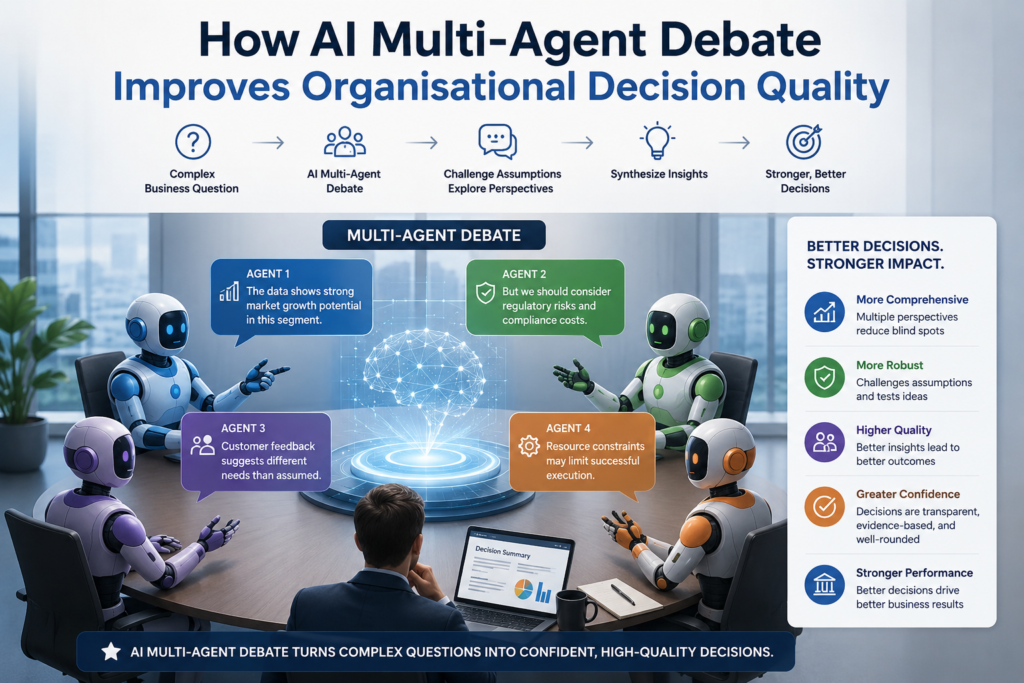
What if, instead of asking one AI to summarise or recommend, you deployed a structured ensemble of specialised AI agents, each interrogating a decision from a distinct analytical perspective, none aware of what the others would say?
That is the premise of AI multi-agent debate, and it is the subject of Atlantic Review’s latest whitepaper.
The framework works by replacing the single-model query-response pattern with an orchestrated debate. Seven agents — a Strategic Analyst, Devil’s Advocate, Financial Stress-Tester, Regulatory Analyst, Skeptic, Optimist, and Risk Analyst examine the same decision independently before a synthesis layer integrates their outputs. The result is a form of adversarial reasoning that surfaces blind spots, stress-tests assumptions, and produces something no standard AI tool provides: a quantified Decision Health Score.
What the Decision Health Score changes
The Decision Health Score is not a recommendation. It is a measure of process quality; a 0 to 100 index that answers the question executives actually need answered before committing to a course of action: not “is this a good idea?” but “is our decision-making rigorous enough to proceed?”
That shift matters more than it might first appear. When the score is high, organisations can move with confidence. When it is low, the score identifies precisely which dimensions – financial, regulatory, strategic, or evidential need attention before a commitment is made.
Over time, organisations that track Decision Health Scores build something more valuable still: an institutional audit trail that documents not just what was decided, but how rigorously it was examined. In an era of increasing accountability to boards, regulators, and investors, that trail is a governance asset.
Who this is for
This whitepaper is written for practitioners: the people who sit in the room where decisions are made and know, from experience, that the process is rarely as rigorous as the output implies. It is for leaders who have watched confident strategic plans collapse on contact with reality, and who are looking for a structured, scalable way to do better.
It is also written for anyone thinking seriously about what AI is actually useful for inside an organisation. Not as a content generator. Not as a search engine. But as a reasoning partner, one that challenges your thinking rather than simply reflecting it back.
Download the full whitepaper: How AI Multi-Agent Debate Improves Organisational Decision Quality is available now as a free PDF download from Atlantic Review. The multi-agent debate methodology described in this series is implemented in Poddle AI, a decision intelligence platform for teams and organisations.
Oludotun Akinbobola writes on decision intelligence, AI strategy, and the future of organisational leadership for Atlantic Review.