


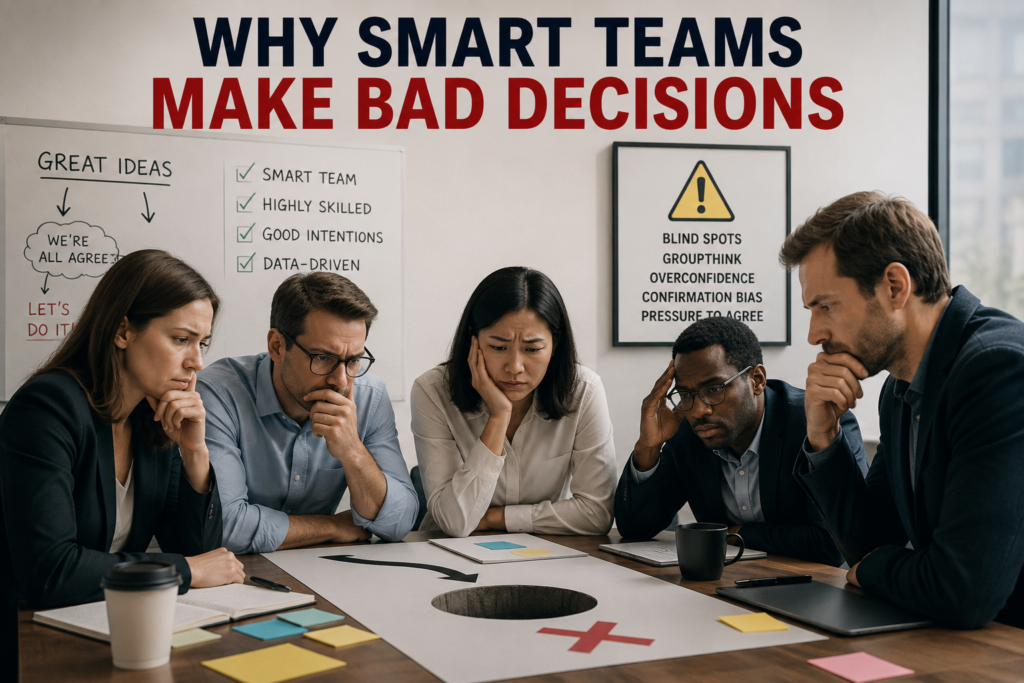
The psychology of groupthink, confirmation bias, and echo chambers in leadership teams, and what to do about it.
It happens in the most capable organisations. A leadership team of experienced, intelligent people gathers to make a critical call; a market entry, a restructuring, a product pivot and they get it wrong. Badly wrong. Not because the data wasn’t available. Not because the talent wasn’t in the room. But because of something far more insidious: the way the room itself thinks.
The uncomfortable truth is that intelligence and seniority offer no immunity to flawed group decision-making. In fact, they can make it worse.
The Illusion of the Smart Room
When a leadership team convenes, the assumption is that collective intelligence produces better outcomes than any individual could achieve alone. Diversity of experience, accumulated seniority, robust debate, the conditions seem ideal.
But research tells a different story. In group settings, individuals routinely suppress dissenting opinions to maintain group cohesion, leading to the reinforcement of collective biases and the suppression of valuable information. The result is not collective intelligence. It is collective blindness dressed up as consensus.
Three psychological forces are usually at work.
1. Groupthink: The Harmony Trap
Groupthink was first identified by Yale social psychologist Irving Janis in the early 1970s. It describes what happens when the desire for harmony within a group overrides honest critical thinking. Normally strong analytical thinkers reframe their concerns to align with the group consensus, not because they’ve changed their minds, but because dissent feels like disloyalty.
The symptoms are recognisable to anyone who has spent time in senior leadership environments: an illusion of invulnerability (“we’ve been right before”), rationalisation of warning signs, and pressure on outliers to conform. Crucially, groupthink doesn’t announce itself. Meetings feel productive. Agreement feels like alignment. The danger is invisible until the decision has already been made.
The consequences can be catastrophic. The Challenger Space Shuttle disaster in 1986 is the defining case study. Engineers had raised serious concerns about the O-ring seals in cold weather. Those concerns were minimised in the rush to maintain consensus among decision-makers. Seven people died, and a $1.2 billion spacecraft was destroyed, not because the right information wasn’t available, but because the group dynamics made it impossible for that information to land.
The stakes in most boardrooms are lower. But the dynamic is the same.
2. Confirmation Bias: Seeing What You Expect to See
Confirmation bias is the tendency to seek out, prioritise, and remember information that confirms what you already believe, while discounting or ignoring evidence that challenges it. It is one of the most well-documented cognitive biases in psychology, and it is particularly dangerous in leadership contexts.
A leader convinced that a particular strategy will succeed will focus on data that supports it, unconsciously filtering out the warning signals that a more neutral observer would notice. When that bias operates at a team level, when the whole room shares the same prior belief the filtering becomes structural. The team isn’t analysing the decision. It is constructing a case for the conclusion it has already reached.
What makes this especially difficult to counter is that it feels like rigour. The team has reviewed the data. They’ve had the discussion. They’ve reached agreement. The process looked thorough. The bias was operating beneath the surface the whole time.
3. Echo Chambers: When the Room Only Reflects Itself
Even well-intentioned leadership teams tend to recruit in their own image, build networks that reinforce existing worldviews, and hold strategy discussions within the same small circle of trusted voices. The result is an echo chamber, not through malice, but through proximity and familiarity.
In group settings, when members conform to the dominant viewpoint or suppress dissenting opinions to preserve social identity, a group polarisation effect amplifies confirmation bias and exacerbates the tendency to ignore alternative perspectives. The team doesn’t just fail to find the best answer. It actively moves away from it, converging on a position that is more extreme than any individual member would have reached alone.
This is how organisations that contain genuinely smart people make decisions that, in retrospect, look baffling. Nokia’s leadership wasn’t unintelligent when they dismissed the threat of the iPhone. Blockbuster’s executive team wasn’t incompetent when they passed on acquiring Netflix. The rooms were full of experienced people. The rooms were also echo chambers.
The Leadership Paradox
Here is the uncomfortable paradox at the heart of this: the conditions that make leadership teams feel most effective shared experience, mutual trust, established relationships, strong culture are precisely the conditions that make groupthink and confirmation bias most likely to take hold.
Seniority compounds the problem. When the most powerful person in the room has a view, it takes extraordinary psychological courage for others to challenge it publicly. The social cost of dissent is high. The cost to the organisation of manufactured consensus is higher, but it is invisible until later.
This is why the problem cannot be solved through culture alone. Telling a team to “speak up” or “challenge assumptions” is necessary but insufficient. The structural conditions of how decisions are made need to change.
What Actually Works
The organisations that consistently make better decisions share one characteristic: they have engineered dissent into the process itself. They don’t rely on individuals being brave enough to push back in the moment. They create systems that make alternative perspectives impossible to ignore.
Ray Dalio institutionalised radical transparency at Bridgewater, building a culture where rigorous debate was not just permitted but required. Amazon uses the “two-pizza team” rule and the six-page memo to force structured thinking before consensus is allowed to form. The US military uses red-teaming, appointing a group whose sole job is to attack the plan as standard practice before major operations.
What these approaches have in common is that they externalise the challenge. They don’t ask individuals to overcome their own cognitive limitations in the moment. They build the challenge into the architecture of the decision.
The Multi-Perspective Imperative
The most significant shift in decision-making practice right now is the move toward structured multi-perspective analysis, deliberately surfacing viewpoints that the team would not naturally generate themselves, before a decision is made rather than after.
This is harder than it sounds. Getting genuinely diverse perspectives in real time, across the full range of angles a decision touches financial, operational, human, competitive, ethical, long-term is a significant undertaking. Most leadership teams don’t have the time, the process, or the diversity of perspective to do it consistently.
This is precisely the problem that Poddle was built to solve. Poddle’s War Room brings multiple AI-powered perspectives to bear on any strategic decision not to replace human judgment, but to stress-test it before it hardens into consensus. It is the structured dissent mechanism that most leadership teams lack: a way to surface the blind spots, challenge the assumptions, and expose the echo chamber before the decision is made.
The goal is not to make decisions by committee or to slow things down. It is to give leadership teams the one thing that groupthink, confirmation bias, and echo chambers systematically deny them: the full picture, before it’s too late to act on it.
The Question Worth Asking
Before your next major leadership decision, ask yourself: whose voice isn’t in the room? Which perspectives haven’t been heard? Which assumptions are being treated as facts?
If the honest answer is that you don’t know or that the room has already reached consensus before those questions were asked, you may already be inside an echo chamber.
The smartest thing a smart team can do is build in the challenge before the commitment is made.
Atlantic Review publishes strategy, leadership, and transformation intelligence for managers and executives.